
Postpartum nurse warns: “Women spend nine months fearing the birth – and what actually scares me starts once they’re home.”
Fourteen years on a mother-baby unit, over 3,000 women in their first days home. What she hears at 3 a.m. isn’t emergencies. It’s women who can’t tell whether they’re having one – because nobody told them where the line is.


I want to start with a night I still think about, because I think it’s the night most of you will have.
It was day nine after my first daughter. 2:40 a.m. I’d just fed her, and when I stood up I felt a gush. The bleeding had been getting lighter for days. Now it was bright red again, and there was more of it than the day before.
So I did what you’ll do. I sat on the bathroom floor with my phone and typed bleeding heavier again day 9 normal? It was, I counted later, the eleventh time that week I had typed the word normal into Google.

Google gave me both answers. One forum said completely normal, it happens when you do too much. The next result said “call your provider immediately.” The one below that said every woman is different.
I did not call. It was the middle of the night, I didn’t want to be the mom who panics over nothing, and I had no idea what “too much” actually meant. Was one pad in an hour too much? Two? I sat there and watched.
At the six-week visit my OB told me that night was normal. Bleeding often picks up again around day seven to ten when you start moving more. Fine. But here’s the part that bothers me to this day: three days later something happened that was not normal, and I didn’t call that time either.

Day twelve. A temperature of 100.6. I felt okay otherwise – a little achy, a little off, which I put down to no sleep. I told myself I’d see how it was in the morning. I said that two mornings in a row. On the third day I couldn’t stand up straight from the cramping, and my husband drove us in.
It was an infection of the uterus. Antibiotics, four days of pumping and dumping, and a sentence from my OB I can still hear: “If you’d waited one more day, we’d be having this conversation in the ER.” The fever line is 100.4. I didn’t know that. Nobody had told me, and I hadn’t known to ask.
Same reason as day nine. I couldn’t tell the difference between normal and not.
Third time around, I wanted the difference
With my second, things went better – not because anyone had given me the lines, but because I remembered what had gone wrong the first time. That’s not a plan. That’s luck with a memory.
Before my third, I noticed something: my birth plan was two pages. My plan for the eight weeks after the birth was zero pages. I don’t think that’s unusual. I think that’s everyone.
So when I was 33 weeks with my third, I went looking for someone who has seen those first weeks not once or twice, but thousands of times. A friend from my prenatal class put me in touch with Renee, a registered nurse who has spent fourteen years on a mother-baby unit and now also takes the after-hours calls for the same hospital.
The first thing she said on the phone was this: “Nobody asks me these questions in month eight. Everyone asks in week one, at three in the morning, when it’s too late to prepare.”
I asked if I could record our conversation. Here it is, shortened. What I did with it afterwards – and how the eight weeks actually went – is at the end.
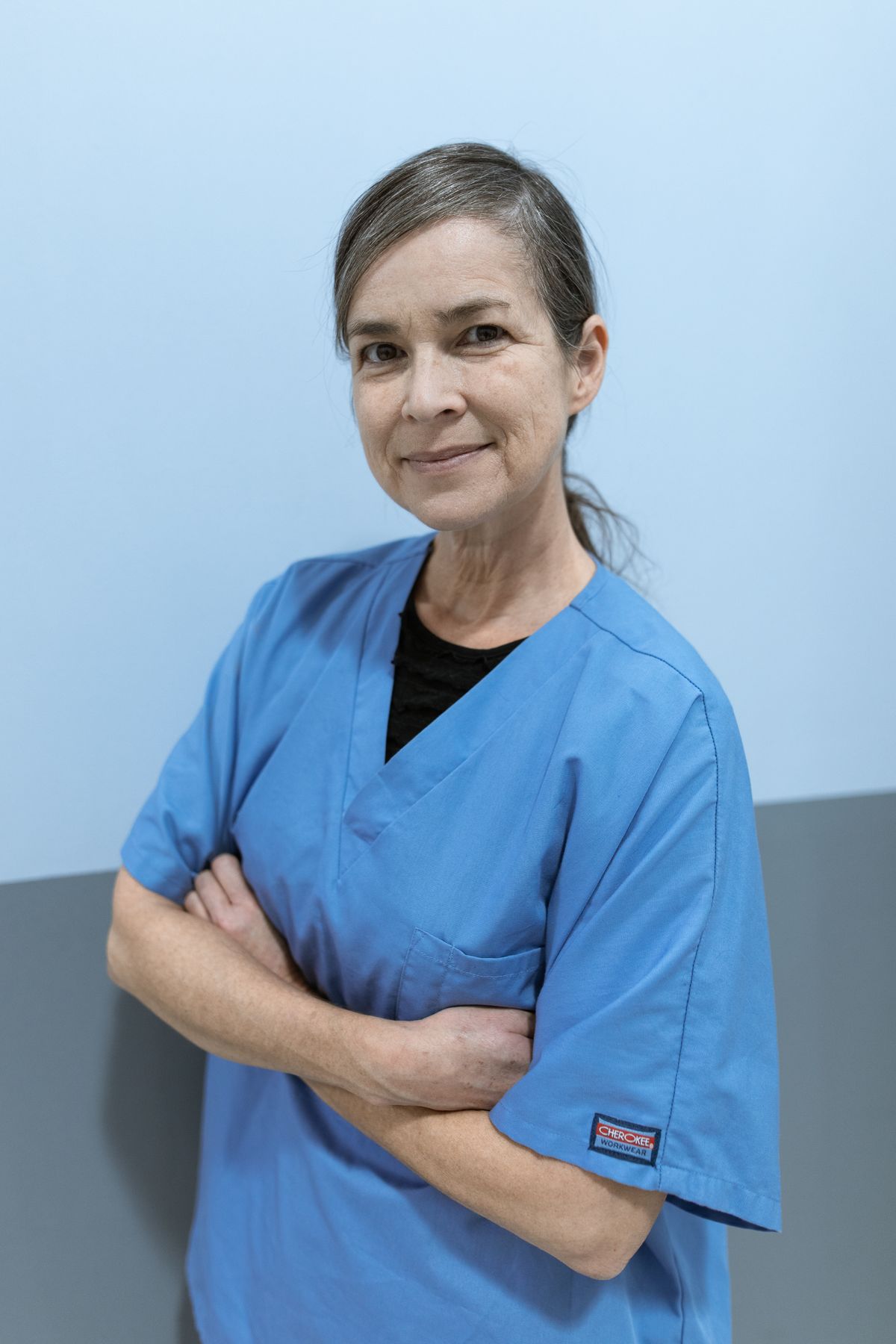
“It’s never about the baby”
Renee, you said the 3 a.m. calls all sound the same. What do they sound like?
Almost every one of them is a version of one question: Is this normal? And it’s almost never about the baby. The baby has a pediatrician, a schedule, a book on the nightstand. The call is about her. The bleeding got heavier. The cramping is worse when she feeds. She’s soaked through her shirt at night and thinks something is wrong. She hasn’t peed in a while and isn’t sure if that matters.
Nine out of ten times I can tell her in thirty seconds that this is expected in week one or week two. The tenth time she should have called hours ago – and on the phone she sounds exactly like the other nine. She can’t tell which one she is. That’s why she’s been sitting with it for hours. And I’m not there the nine times she doesn’t call. The line has to be on her fridge before she needs it, not in my head.
People say “just call if you’re worried.” That doesn’t work, because worried is the default state of week two. She can’t call about everything, so she calls about nothing.
Why hasn’t anyone told her before?
Because of where the gap is. Your childbirth class ends with the birth. The hospital sends you home after one or two nights with a folder you will never open again. Your next appointment with your own provider is at six weeks. In between, there are five weeks where nobody sees you – and those five weeks are when nearly everything happens. The bleeding changes color four times. The milk comes in. The afterpains. The night sweats. The first time you laugh and leak.
We spend nine months preparing women for a twelve-hour event and then hand them a folder for the eight weeks after.
And I want to say this clearly, because people think the dangerous part is the birth: more than half of the serious complications after a birth happen after the first week, at home, not in the hospital. That’s CDC data, not my opinion. The women I see come in late are never the careless ones. They’re the ones who didn’t want to bother anyone.
What are the things you hear most that are actually normal?
The bleeding getting heavier again around day seven to ten – it usually means she did more that day. Afterpains that are worse while breastfeeding, and much worse with a second baby. Night sweats in the first two weeks, sometimes soaking. A fever right under 100.4 when the milk comes in. Not having a bowel movement for two or three days.
Quick test, because I couldn’t have answered it on day nine: how much bleeding is too much? One pad an hour? Two?
Most women I ask say two, or “a lot.” Every one of those has a line – the exact point where normal stops and you pick up the phone. Heavier bleeding is normal, more than one large pad an hour for two hours is not. A slight temperature is normal, 100.4 or higher gets a call the same day. Not urinating for a few hours is normal, six hours is not. The line is what she needs at 3 a.m. Not reassurance. A number.
Four rules that are the same for every mom
- Bleeding: heavier again around day 7–10 is expected. Soaking more than one large pad an hour, two hours in a row, or clots bigger than an egg, is a call – right away.
- Fever: 100.4 °F or higher means call your provider today, even if you feel fine otherwise.
- Peeing: empty your bladder every two to three hours in the first days, even without the urge. Nothing for six hours is a call.
- Headache: a severe headache with vision changes or sudden swelling of face or hands is a call right away – possible up to six weeks after the birth, even if your pregnancy was easy. Almost nobody knows this one.
Everything beyond these four – how your bleeding runs after a C-section, when your first exercise is, what your week two looks like – depends on your birth and your dates. That’s the part no book can give you.
Free 2-minute quiz · your plan as a PDF within minutes

Why the books don’t help at night
Most of us have a pregnancy book. Why doesn’t that cover it?
Because they’re written for everyone, so they hedge. “Some bleeding is normal.” How much? For whom? At 3 a.m. you don’t need a chapter, you need a line, and a general book can’t draw one. Whatever she asks at 3 a.m. – a forum, a book, her phone – she’s asking because nobody told her beforehand. And she’s asking scared, with the baby on her arm, typing in her birth and her day. That’s the wrong hour for a good answer.
Google’s answer to Sarah was “every woman is different.” Is that true?
It’s the truest sentence in postpartum care and the most useless one, because it’s where the conversation ends instead of where it starts.
Every body is different – but not randomly different. It’s different in ways you can already name in month eight. How you’re giving birth: a C-section changes the bleeding pattern, adds an incision with its own warning signs, and turns getting out of bed into a technique. When: your due date decides which calendar day is day nine. How you’ll feed: breastfeeding changes the afterpains, the night sweats, when your period comes back. And who’s home with you: “rest” means something else when you’re on your own most of the day.
A book can’t know any of that about you, so it hedges. A plan that starts from you doesn’t have to. That’s the whole difference between “some bleeding is normal” and “more than one pad an hour is not.”
So what do you tell women to do instead?
Before the birth, not after. For each thing that will happen to your body, have three answers written down somewhere you can find at night: what’s normal, how long it lasts, and the exact point where you call. Written for your birth, not for “a birth.” And on a real calendar – if your due date is October 5, week two is October 12 to 18, and that’s what should be on the paper. Then you’re not counting at 3 a.m., you’re reading. The point isn’t a better answer at night. It’s that there is no question left at night.
Most women I say this to nod and never do it, because it’s a lot of work in month eight and nobody has handed them a template. That’s the whole problem in one sentence.
500+ mothers have built their plan this way · rated 4.9/5
Build my postpartum plan →Free 2-minute quiz · built from your answers, not a template
What ended up on my fridge – and what happened on day nine this time
I’ll be honest, I didn’t build Renee’s three-answers sheet myself. The friend who had introduced me to Renee had one on her fridge, and she sent me the link. I’m only mentioning it because it is exactly what Renee described, and because I’ve now lived eight weeks with it.
It’s a short quiz – fifteen questions, about two minutes. Fifteen questions about you: what kind of birth you’re planning, your due date, whether it’s your first, how you plan to feed, who’s actually going to be at home with you, what you eat, what worries you most. If you don’t know yet how you’ll give birth, the plan covers both. Then it puts together a plan for your first eight weeks from those answers – every chapter, every date, every list. My sister did it two weeks after me: vaginal birth, bottle, her mom staying for a month. We compared. Her recovery chapter is about stitches and the perineum, mine about the incision and how to get out of bed. Her feeding chapter is about ounces and bottles, mine about latch and supply. Her week two is different dates, and her partner page is a page for her mom. Same quiz, two different documents. That’s the point.
Two pages of it went on my fridge before the birth: the eight-week calendar with my actual dates – week two said “Jul 27–Aug 2” – and the one-page card with three columns, call now, call today, wait. With the numbers, for my birth, and the baby on the same page.
That was the part I expected. The part I didn’t: it doesn’t stop at week two.
There’s a recovery program in it, and it doesn’t say “listen to your body.” It says: weeks one and two, breathing and pelvic floor only, two or three minutes lying down, no tensing the belly, nothing against resistance. Week three, on August 3 in my case, the first gentle exercises, ten minutes on five days. And, in bold, the sentence I wish I’d had after my first: no sit-ups and no planks until the pelvic floor holds – with a C-section, nothing that pulls on the incision before it stops tugging when you turn. Phase three only after your provider clears you. Dates, not feelings.
The baby has his own part on the same calendar: back to birth weight by day ten to fourteen, the first well-child visit three to five days after birth, the crying peak around week six – so when week six came and he cried every evening, I didn’t google that either.
And my husband got one page. One. What to take over in weeks one and two, so I never had to explain it at night. That page is the reason he knew the same lines I did.
All of it as a PDF within minutes of the quiz: on my phone at 3 a.m., printed on the fridge by day. I did it at 33 weeks. If your due date is closer than that, do it tonight – the calendar and the card are the part you’ll use first, and they take two minutes. If you’re earlier: the preparation part starts at week 30, so every week earlier is a week more of it you actually use.
I sent the warning-signs card to Renee. Her reply, word for word: “That is the sheet. I would put the fever line in bold.” (It is in bold.)
Day nine came, as it does. Bleeding heavier again after a long afternoon with all three kids. I stood in the same bathroom as six years ago, looked at the fridge instead of my phone, and read: heavier again around day 7–10 is expected; more than one pad an hour for two hours is not. One pad. I went back to bed. That was the whole event.
Day thirteen, a temperature of 100.2. Six years ago I’d have waited. The card said 100.4 gets a call today, under that: watch, drink, recheck in four hours. I rechecked. 99.8. Done.
Once, the card said “call today” – a hard, hot spot in one breast on day 18 – and I called at 9 a.m. instead of at 3 a.m. two days later. Early mastitis, caught early. Three days of antibiotics instead of a week, and I never stopped feeding.
It didn’t make the nights easy. Nothing makes them easy. It made them quiet. In eight weeks I asked my phone exactly nothing about my body, my husband knew the same lines I did, and I called my provider once, at the right time, for the right reason. That’s the outcome. Not a miracle – just the difference between guessing and reading. That’s what a plan built from your answers does that a book can’t: it already knows your birth, your dates, your feeding, your home – so at 3 a.m. there’s nothing left to figure out.
Over 500 women have made their plan this way so far, rated 4.9 out of 5. One of them, Maya, 31, wrote what I would have written: “I felt more supported, more prepared, and much more grounded in those first few weeks.”
Get your personalized postpartum plan →Starts with a free 2-minute quiz. Takes two minutes now – a lot longer at 3 a.m.
The preparation part starts at week 30 – every week earlier is a week you actually use.
This article is sponsored by Kind Plans, the maker of the personalized postpartum plan mentioned above. Sarah Mitchell writes for Postpartum Notes. The nurse’s name and photo have been changed at her request; her statements were reviewed by her before publication. Numbers in this article follow ACOG and AAP guidance; the share of complications occurring after the first week refers to the CDC’s pregnancy-related mortality data (53 % of deaths occur 7–365 days postpartum). Nothing here is medical advice: if you are worried about your bleeding, a fever or your baby, call your provider or 911.
Privacy · Terms · Reelone Media GbR, Lauenburger Allee 10, 47269 Duisburg, Germany · hello@kindplans.com